
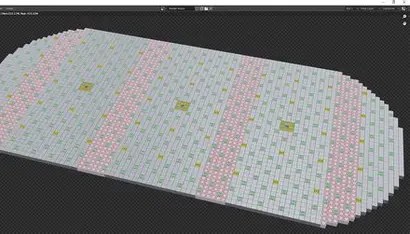
hi kids, today we’ll talk about the RBMKP-2400

The Reactor Design
The RBMKP-2400 was a Soviet nuclear reactor that never left the design phase. It was intended to produce 2400 MW electrical power at over 6500 MW of thermal output, making it one of the most powerful civilian reactors ever made. Unlike earlier RBMK models, which were built in a cylindrical configuration, the RBMKP-2400 was designed in a new rectangular, modular form.

This meant that it could be assembled from factory-built sections on site and, in theory, could be expanded in length almost indefinitely to achieve even greater power.
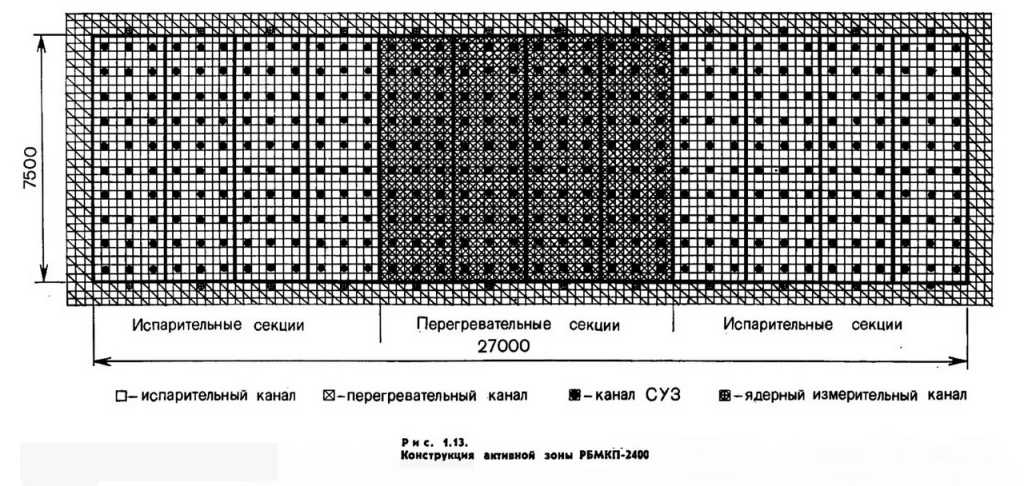
^ Испарительный канал = Evaporator channel, Перегревательный канал = Superheater channel, Канал СУЗ = Control & Protection System channel (control rods), Ядерный измерительный канал = Nuclear instrumentation channel, Испарительные секции = Evaporator sections, Перегревательные секции = Superheater sections, Рис. 1.13. Конструкция активной зоны РБМКП-2400 = “Fig. 1.13. Design of the active zone of the RBMKP-2400” **Translation by ChatGPT
The diagram above further dissects the reactor core design further. The rectangle (27,000mm x 7,500mm = 27m x 7.5m) is the active zone. The outer regions (Испарительные секции, evaporator sections) contain evaporator channels, where water turns into steam. The central region labeled Перегревательные секции (Superheater section) contains the superheater channels. Here, the steam is further heated into a higher temperature. The black squares are Control & Protection System channels (СУЗ), where the control rods are. The small, patterned squares with a dot are nuclear instrumentation channels, to monitor neutron flux and reactor power distribution.
The most interesting part of this reactor is its treatment of steam. Traditional RBMK units produced saturated steam from the reactor channels, but the RBMKP-2400 brought in the new in-core steam superheating. These channels would raise steam temperatures up to 450 degrees Celsius. This improved turbine efficiency and thermal efficiency.
The reason why this new variant was called the RBMKP and not the RBMK was because the ‘P’ stood for rectangular (Прямоугольный, Pryamougolnyy). As the name itself suggests, the reason for this name is due to the rectangular core instead of the cylindrical core in normal RBMKs.
Deployment & Cancellation
Plans for the RBMKP-2400 included the construction of two units at the Kostroma Nuclear Power Plant in central Russia. These reactors would have been the largest RBMKs ever built, overpowering the RBMK-1500 at Ignalina in Lithuania. The modular design of the reactor even suggested a future of even larger reactors, such as the RBMKP-4800 could be possible by extending the rectangular core with additional sections. No reactor of power this large has ever been built, with the most powerful one being as of 2018 the 1750MW electric EPR (European Pressurized Reactor).
The RBMKP-2400 never advanced beyond the design phase, mostly due to the Chernobyl disaster of 1986. The accident revealed the problems of the RBMK family, such as its positive void coefficient, lack of proper containment, and vulnerability at low powers. While the RBMKP-2400 was an overall step ahead in terms of safety than the RBMK-1000, it still inherited the same weaknesses. After Chernobyl, Soviet nuclear policy shifted towards more safer designs such as the VVER PWRs, and the RBMK was abandoned.
There was also going to be a RBMK-2000 and a RBMK-3600 variant, which also never left the design phase. It was designed to have 2000 and 3000MW electric power respectively. The RBMK-2000 would have had an increased channel diameter and number of fuel rods per fuel assembly while maintaining the same dimensions of the reactor core as the RBMK-1000 and RBMK-1500. The RBMK-3600 presumably similarly to the RBMK-1500 would have added turbulators to the RBMK-2000 design to increase heat removal.
that’s it for today kids, good night.
 DasBlog
Leave a comment