
hi kids, today we’ll see how xenon affects reactors. (short one today)

We all know how a nuclear reactor works. Or at least, the basics of it. A neutron hits a uranium atom, splits it into two which creates heat, and that heat boils water to spin the turbines that generate electricity. But what are the challenges of running a reactor? There are several, such as malfunctions and xenon poisoning. Unlike malfunctions, xenon poisoning occurs without a fault in the system, as it is a byproduct of fission.
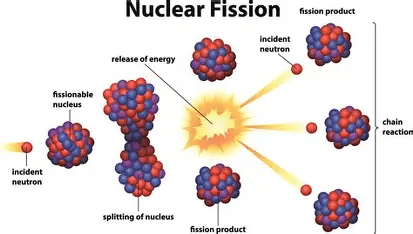
This phenomenon is caused by a build-up of the product xenon-135 (Xe-135). Xe-135 is formed both directly from fission and indirectly from the decay of iodine-135, another fission product. What makes xenon-135 important is that it has an extraordinarily high neutron absorption cross section. In other words, it absorbs neutrons so effectively that it can temporarily suppress the chain reaction.
After a reactor is shut down or its power reduced, iodine-135 continues to decay into xenon-135, but with fewer neutrons in the reactor due to the lower power, the xenon isn’t burned away by neutron absorption. This can cause a xenon peak, where reactivity is heavily suppressed, making it difficult to restart the reactor for several hours. This is called the “iodine pit” or “xenon pit”.
Operators must plan around the xenon poisoning. For example, when lowering power, they anticipate that xenon will buildup and adjust control rods or soluble boron concentration to compensate. If not done properly, xenon poisoning can delay restarts and disrupt power output.
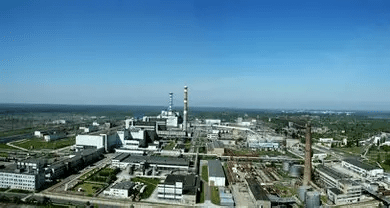
The most notable one of this is during the Chernobyl accident. At Chernobyl Unit 4, the operators were preparing for a safety test that required lowering reactor power. However, when the reactor power was reduced too quickly, the reactor slipped into a xenon pit. The concentration of xenon-135 became so high that the reactor’s power dropped to near-zero (~30MWt). Instead of waiting for xenon to decay naturally, which will take a lot of time, the operators attempted to overcome the pit by withdrawing most of the control rods and reducing boron concentration in the coolant.
When they tried to raise power again, the reactor became xenon-compensated but dangerously unbalanced. Once the turbine trip occurred during the test, the sudden change in coolant flow, the graphite on the control rods, and the RBMK reactor’s positive void coefficient triggered a runaway power surge. Within seconds, reactor number four exploded at 1:23:45AM.
 DasBlog
Leave a comment